PAIR Master is a software product developed by Neustel Software, Inc. to provide for simple downloading, viewing and management of USPTO Private PAIR documents listed in a Private PAIR Correspondence Notification e-mail from the USPTO. You can download the free beta release at www.PAIR-Master.com (the beta version automatically expires January 1, 2010).
USPTO Grants 600,000th Design Patent
A ceremony was held yesterday by the USPTO where Director Kappos awarded design patent number 600,000 to a business located in Spanish Fork, Utah. Senator Hatch attended the ceremony.
Patent Owner Must Sue Contractor for U.S. Government in Court of Federal Claims
On September 30, the Federal Circuit upheld a District Court summary judgment ruling that Advanced Software Design Corporation must sue a contractor for the U.S. Government in the Court of Federal Claims and not in District Court where the claim was originally filed. The Federal Circuit’s ruling was based on the fact that the acts of infringement by the contractor were “by or for the United States” pursuant to 28 U.S.C. 1498. In particular, the U.S. Treasury Department gave “authorization and consent” for the manufacture by the U.S. Government.
USPTO Rescinds Controversial Proposed Patent Regulations
The USPTO filed a joint motion with GlaxoSmithKline to dismiss the lawsuit related to regulations affecting the ability to secure patent protection for inventions. Director of the USPTO David Kappos stated:
The USPTO should incentivize innovation, develop rules that are responsive to its applicants’ needs and help bring their products and services to market. These regulations have been highly unpopular from the outset and were not well received by the applicant community. In taking the actions we are announcing today, we hope to engage the applicant community more effectively on improvements that will help make the USPTO more efficient, responsive, and transparent to the public. We are grateful to GlaxoSmithKline for working with us to file this joint motion to both dismiss the appeal and vacate the district court’s decision. This course of action represents the most efficient way to formally and permanently move on from these regulations and work with the IP community on new ways to take on the challenges these regulations were originally designed to address.
While the USPTO’s decision was expected based upon prior comments from the USPTO, this joint motion is excellent news for all patent applicants to avoid being severely limited in seeking patent protection on important technology.
LITIGATION HISTORY. In August 2007, the USPTO published new rules intended to help improve examination efficiency and quality. The proposed rules would have permitted a patent applicant to only file two (2) continuation applications and one (1) request for continued examination (RCE) per application family as a matter of right. For a third or subsequent continuation application or RCE, the applicant would have had to make a case to the USPTO to show why the additional filing was needed. In the fall of 2007, GlaxoSmithKline and Dr. Tafas filed a lawsuit against the USPTO in U.S. District Court of the Eastern District of Virginia seeking a preliminary injunction to stop the new rules. In April 2008, the Court granted a permanent injunction against the new rules and the USPTO appealed to the U.S. Court of Appeals for the Federal Circuit which partially ruled in favor of the USPTO. A rehearing was granted by the Federal Circuit with additional briefing to have started in the coming weeks.
USPTO Proposes Significant Changes to Examiner Count System
Here is some news from the USPTO that could significantly affect — in a good way — how patent applications are examined. Director of the United States Patent and Trademark Office (USPTO) David Kappos today unveiled a series of proposals to bring significant change to the examiner “count system” – the methodology for determining the time a patent examiner has to complete a patent examination and how much credit is given for each stage of an examination. The proposal was developed by a task force comprised of senior managers in the Patents organization and leadership of the Patent Office Professional Association (POPA), the union that represents patent examiners.
“Secretary Locke directed us to adopt an ambitious agenda to address the significant challenges at USPTO and that’s what we’re doing,” Kappos said. “We’ve worked closely with labor representatives to propose a long-overdue transformation of the count system. We hope to move expeditiously toward adoption of these changes that will benefit examiners, the agency and the IP community as a whole.”
The full proposal is available on the USPTO Web site here.
The proposed changes are designed to:
— Set the foundation for long-term pendency improvements.
— Increase customer satisfaction by incentivizing quality work at the beginning of the examination process.
— Encourage examiners to identify allowable subject matter earlier in the examination process.
— Rebalance incentives both internally and externally to decrease rework.
— Increase examiner morale and reduce attrition.
The proposed changes represent what would be the most significant changes to the count system in more than 30 years. The count system was created in the mid-1960s and hasn’t been revised since 1976.
The proposal addresses the following areas of change:
- Improved working conditions: While the proposal increases the time examiners have overall, it provides incentives to encourage examiners to do a high-quality first action, and shifts resources from a focus on examiner recertification to front-end quality improvements. This change in incentives will ultimately encourage examiners to dispose of applications more quickly.
- More time for examiners: The proposed changes will give examiners more time overall, more time for a first action on the merits, and time for examiner-initiated interviews, while decreasing credits on requests for continued examination (RCEs)* and providing consistent credits for transferred or inherited amendments.
- Process changes: These changes will increase work credit certainty for examiners, increase fairness to applicants, and balance the load on IT systems.
“These proposed changes will lead to earlier identification of patentable subject matter, which will benefit both the USPTO and applicants,” Deputy Commissioner for Patents Peggy Focarino said. “Over the long term, we believe these changes will promote quality examination and set a foundation for pendency improvements.”
POPA President Robert Budens also expressed support for the proposed changes.
“The count system is sorely in need of re-tooling, and we feel this proposal is a necessary first step toward giving examiners the time they need to do a quality examination,” Budens said. “We are pleased to have been involved in developing this proposal and we are hopeful it is one that our members will support.”
The task force expects the improvements in overall efficiency caused by getting to examination more quickly will offset the increased time provided for examination. And, importantly, they expect improved quality by providing examiners with more time up front in the first office action to do a thorough search and examination. The task force is prepared to propose adjustments as warranted should the changes not yield the anticipated results.
This proposal is intended to be part of an iterative process of improvements to the count system. The task force will measure the effects of these changes and gather internal and public feedback, and will meet on a regular basis to monitor progress and consider additional changes.
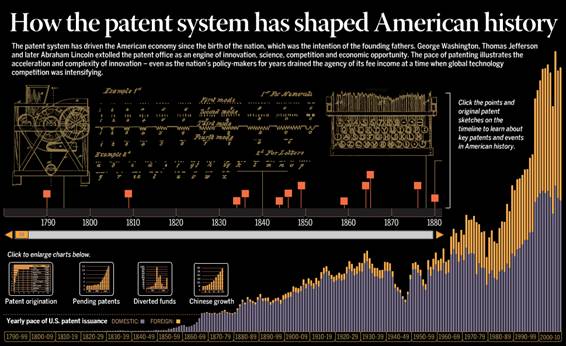
Interactive Chart on How Patents Have Shaped American History
The Milwaukee Wisconsin Journal Sentinel has a great interactive chart showing how the patent system has shaped American history. See the interactive chart at http://www.jsonline.com/business/53244432.html.
USPTO Online Chat Session (9/16/09)
The U.S. Patent & Trademark Office will hold an online chat session today (9/16/09) for inventors at 2-3 pm ET. http://tinyurl.com/qwvq5n
Google Awarded Design Patent for Interface (US D599,372)
On September 1, 2009, google was awarded United States Patent No. D599,372 for its graphical user interface (GUI). This is a design patent and therefore only protects the ornamental features of the Google search page (i.e. the patent does not protect the function of the interface or how Google does its searching). Design patents last for 14 years from their issue date, so this patent will expire on September 1, 2023. Interesting, it appears that Google’s current website design would not infringe this patent because of the differences in appearances and layout. Below is a figure from the Google patent illustrating the ornamental design Google received a patent on:

USPTO Issues Interim Guidelines for 35 U.S.C. 101
Admitting that the law surrounding 35 U.S.C. 101 relating to what is patentable subject matter is in “flux,” the USPTO has provided to its Examiners some interim guidelines to assist in the examination of patent applications. While the guidelines do not provide any substantive law changes, they do provide some valuable insight into how USPTO Examiners will be examining patent applications. See the Interim Guidelines.
New USPTO Director: “Patent quality does not equal rejection.”
It appears that the new USPTO Director (Kappos) is taking little time to change the direction of the USPTO from rejecting patent applications to actually granting patent applications (the USPTO allowance rate has recently dropped close to 42% from a previous average of 70%). In a recent e-mail to Patent Examiners, Director Kappos stated the following which is welcome news to everyone involved with patents:
One key is to expeditiously identify and resolve issues of patentability—that is getting efficiently to the issues that matter to patentability in each case, and working with applicants to find the patentable subject matter and get it clearly expressed in claims that can be allowed. The examiner and the applicant share the responsibility for the success of this process.
On the subject of quality, there has been speculation in the IP community that examiners are being encouraged to reject applications because a lower allowance rate equals higher quality. Let’s be clear: patent quality does not equal rejection. In some cases this requires us to reject all the claims when no patentable subject matter has been presented. It is our duty to be candid with the applicant and protect the interests of the public. In other cases this means granting broad claims when they present allowable subject matter. In all cases it means engaging with the applicant to get to the real issues efficiently—what we all know as compact prosecution.
When a claimed invention meets all patentability requirements, the application should be allowed expeditiously. … [B]y engaging with applicants early on, we certainly can get to the point more quickly, and efficiently allow those claims that are entitled to patent protection.
Only time will tell if the Patent Examiner’s actually follow the lead of the new Director.
 InventLaw.com - Patent and Invention Information